Course Syllabus
Advanced String Crossing Methods
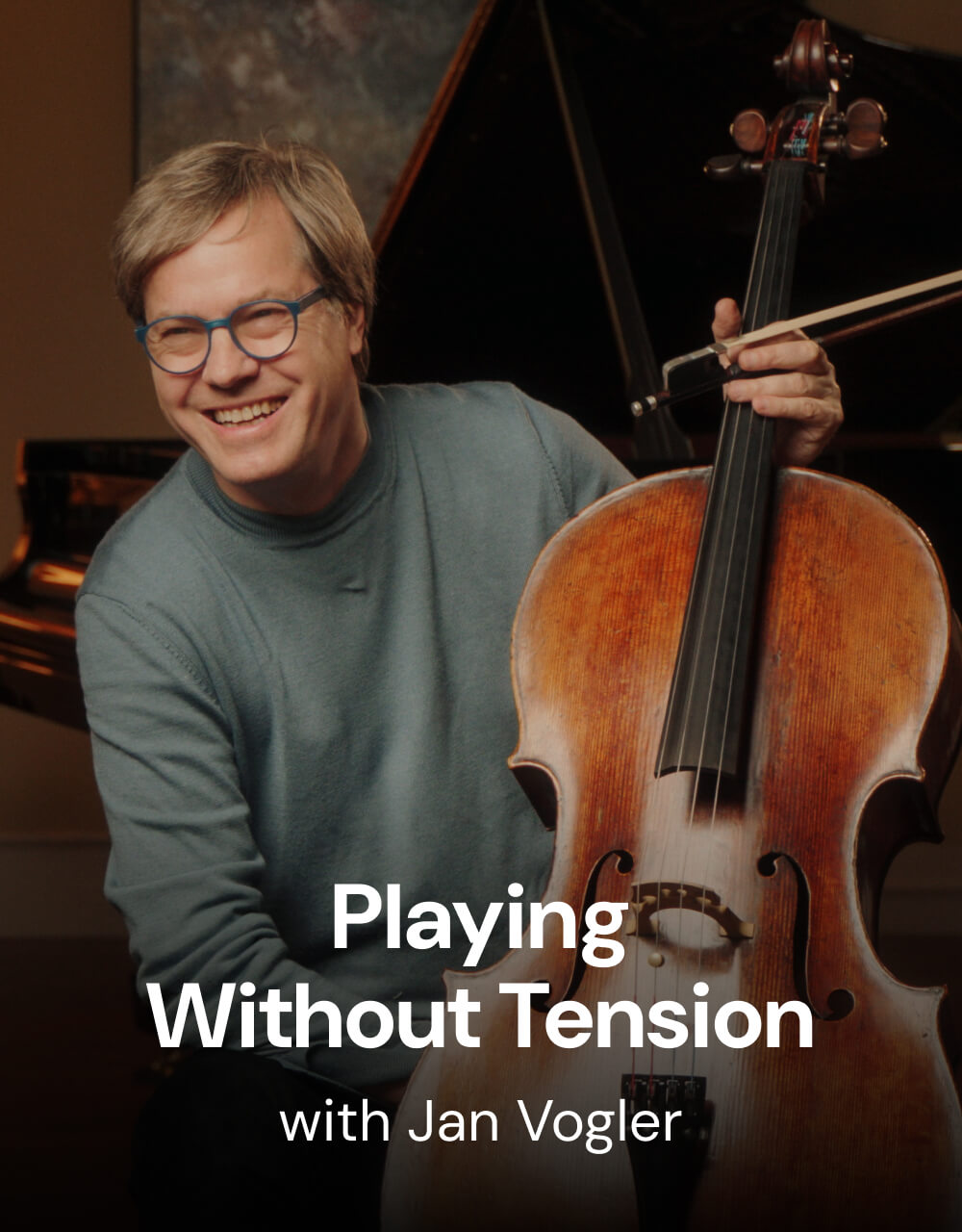
In this lesson, Jan Vogler goes into detail about arm weight, pronation, and even the history of the bow. We learn about bow changes and Vogler tells us that "String crossings are all about strategy." He also emphasizes the role of the elbow as a lever, and tells us that the shoulder needs to play a very minimal role in cello playing overall. Vogler puts a special significant on the music of Bach, as this is filled with strong crossings.
Freeing the Sound
In this lesson, we explore the relationship between bow pressure, bow speed, and contact point. Vogler teaches us that we should first begin with very slow scales, to feel how the weight transfers through the arm, and then think about where and how we draw the bow. We learn about envisioning the sound first in our head and then using the tools at our disposal to create that sound on the cello. As Vogler reminds us, at a certain point, we must learn to trust our instincts.
"Hiding" Your Bow Changes
In this lesson, we learn how to make smooth bow changes that serve the music. Contrary to what many people think and teach, if you can keep your bow speed constant till the last second, you will have a better bow change than if you slow down the bow. Vogler encourages us to watch videos of the great violinists, such as Heifetz, Oistrakh, or Menuhin. Vogler notes how un-sensationally they make bow changes, but how sensational the results are! We also study the role of the wrist and fingers when it comes to bow changes.
Click here to download the course workbook PDF and see the full syllabus →