Course Syllabus
Experiments with the Magical Sounding Point
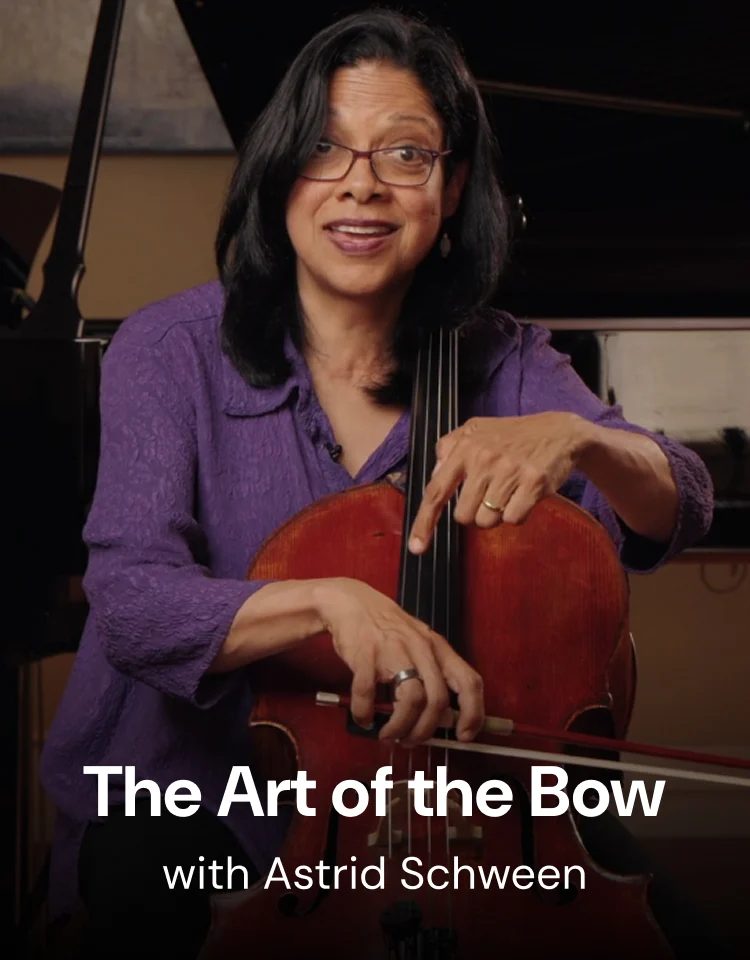
In this lesson, we learn about sound production and its relationship to bow speed and bow placement. As Schween explains, it's important to always know where the sound is produced. Near the bridge? Near the fingerboard? Schween describes the sounding point as taking place in three "tracks," and encourages us to explore this. Schween reminds us that music is made of gestures, and we need to practice more than we need to get extra comfortable.
Freeing the Sound
In this lesson, we explore the relationship between bow pressure, bow speed, and contact point. Vogler teaches us that we should first begin with very slow scales, to feel how the weight transfers through the arm, and then think about where and how we draw the bow. We learn about envisioning the sound first in our head and then using the tools at our disposal to create that sound on the cello. As Vogler reminds us, at a certain point, we must learn to trust our instincts.
Physical Posture and the Bow
In this lesson, Schwarz demonstrates a few simple principles that can help us project our sound without modifying the instrument itself. The beginner will be able to apply these instantly to any music they’re working on, while the more advanced learner will find this to be a succinct and helpful reminder.
Sound Colors and Bow Division
In this lesson, we learn about the use of the bow and how we can create different sounds and colors. We learn about bow division and ways to plan not just how much bow we use, but also where between the bridge and fingerboard to play. We also get introduced to Clein's system of thinking about the different characteristics of playing on the bridge, on the fingerboard, and in between.
Know your Bow
In this lesson, we learn how important it is to become deeply familiar with the stick of our bow. We are encouraged to practice making circles with our bow, but always in rhythm! All music, exercises included, must be in rhythm! Feel the weight of the bow shifting as you go back and forth on the bow. Develop the flexibility of the fingers. Professor Moses likes using exercises by Feulliard to feel the back and forth of the bow, and we also study techniques of legendary cellists Casals, Starker, and Rose.
Click here to download the course workbook PDF and see the full syllabus →