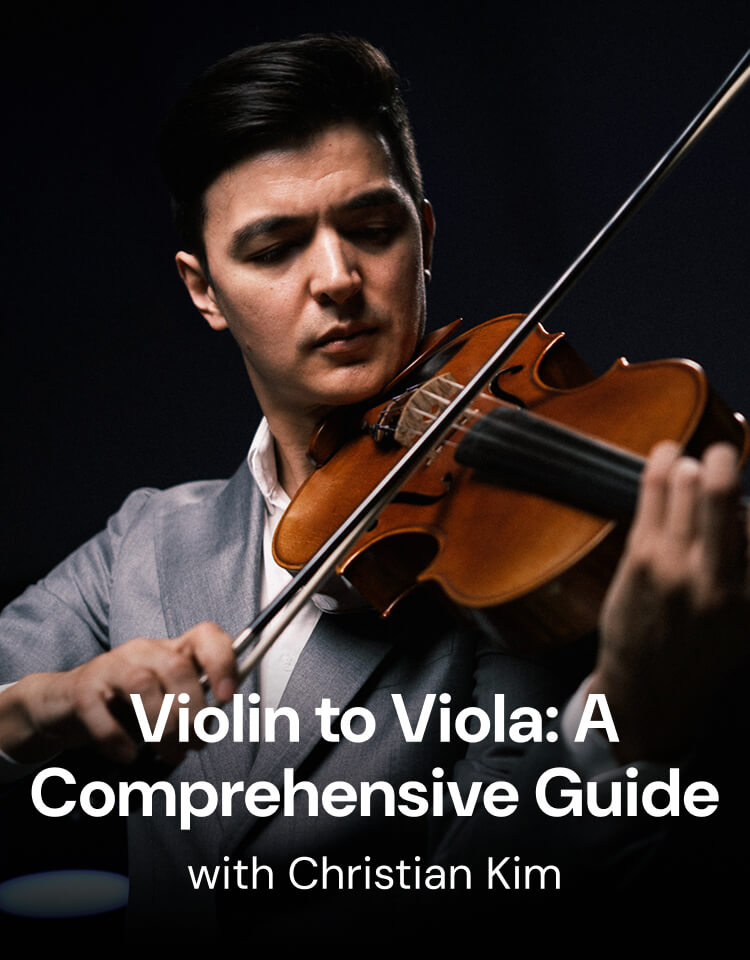
Course Syllabus
I. Largo
The opening movement is explored through its dance-like three-two meter, with attention given to maintaining momentum and phrasing direction at a moderate tempo. Kim breaks down key technical challenges such as string crossings, register changes, and finger coordination, offering clear practice methods for clean execution. He also discusses how tonal shifts, harmonic surprises, and melodic contour can inform musical decisions, while highlighting the importance of natural decay, open string usage, and disciplined fingering choices in Baroque performance.
II. Allegro
In the second movement, Kim focuses on shaping lyrical lines with control and restraint. He addresses balance between sustained tone and natural decay, emphasizing clarity of sound and coordination between the hands. The lesson highlights how subtle harmonic changes and melodic tension can guide phrasing choices, encouraging players to listen deeply and allow the music’s structure to shape expression without excess weight or vibrato.
III. Andante
The Andante is approached as a study in texture, nuance, and expressive timing. Kim explains how pairs of slurred notes function as a stylistic and textural element, shaping phrasing through gentle decay rather than continuous sustain. He draws attention to moments of harmonic surprise and suspension, showing how these points can be used to create drama and direction. The lesson also discusses pacing, coordination, and the option to remain faithful to the written line while leaving room for later exploration of embellishment.
IV. Presto (Part 1)
Christian Kim introduces the Presto finale, explaining its two-part form and how to feel the movement in larger beats rather than strict four. He focuses on articulation, natural sound decay, and efficient bow placement to support speed and clarity. The lesson addresses abrupt string crossings, coordination between the hands, and strategic practice methods that break complex actions into clear preparatory steps. Christian also discusses fingering options, position choices, and how to manage passagework and chords with economy, helping players build fluency while maintaining a light, forward-moving character.
IV. Presto (Part 2)
Continuing the finale, Christian explores how Telemann transforms familiar material through minor mode color, register shifts, and increasing harmonic tension. He offers detailed guidance on tuning fifths, preparing double stops early, and making intentional choices between open strings and fourth finger to balance sound color and efficiency. The lesson also examines bass-line driven passages, showing how to shape momentum and direction through selective emphasis. Christian concludes by tying the movement together with practical advice on repeats, pacing, and delivering a confident and stylistically grounded ending to the concerto.
Click here to download the course workbook PDF and see the full syllabus →